10 Best Enterprise LMS Platforms in 2026 (Ranked & Reviewed)
Corporate training in 2026 looks nothing like it did five years ago. Enterprises now expect their learning management system to deliver AI-driven tutoring, proctored assessments, automated certification, and…

Corporate training in 2026 looks nothing like it did five years ago. Enterprises now expect their learning management system to deliver AI-driven tutoring, proctored assessments, automated certification, and mobile-first learning — all while keeping ownership of their data. Choosing the best enterprise LMS in 2026 means balancing features, flexibility, and total cost of ownership.
To make that decision easier, we evaluated dozens of platforms on ease of use, AI capabilities, assessment tools, compliance readiness, deployment flexibility, and pricing. Here are the 10 best enterprise LMS platforms in 2026.
1. LMS Advisor — Best Overall Enterprise LMS in 2026
[caption id="attachment_7114" align="aligncenter"]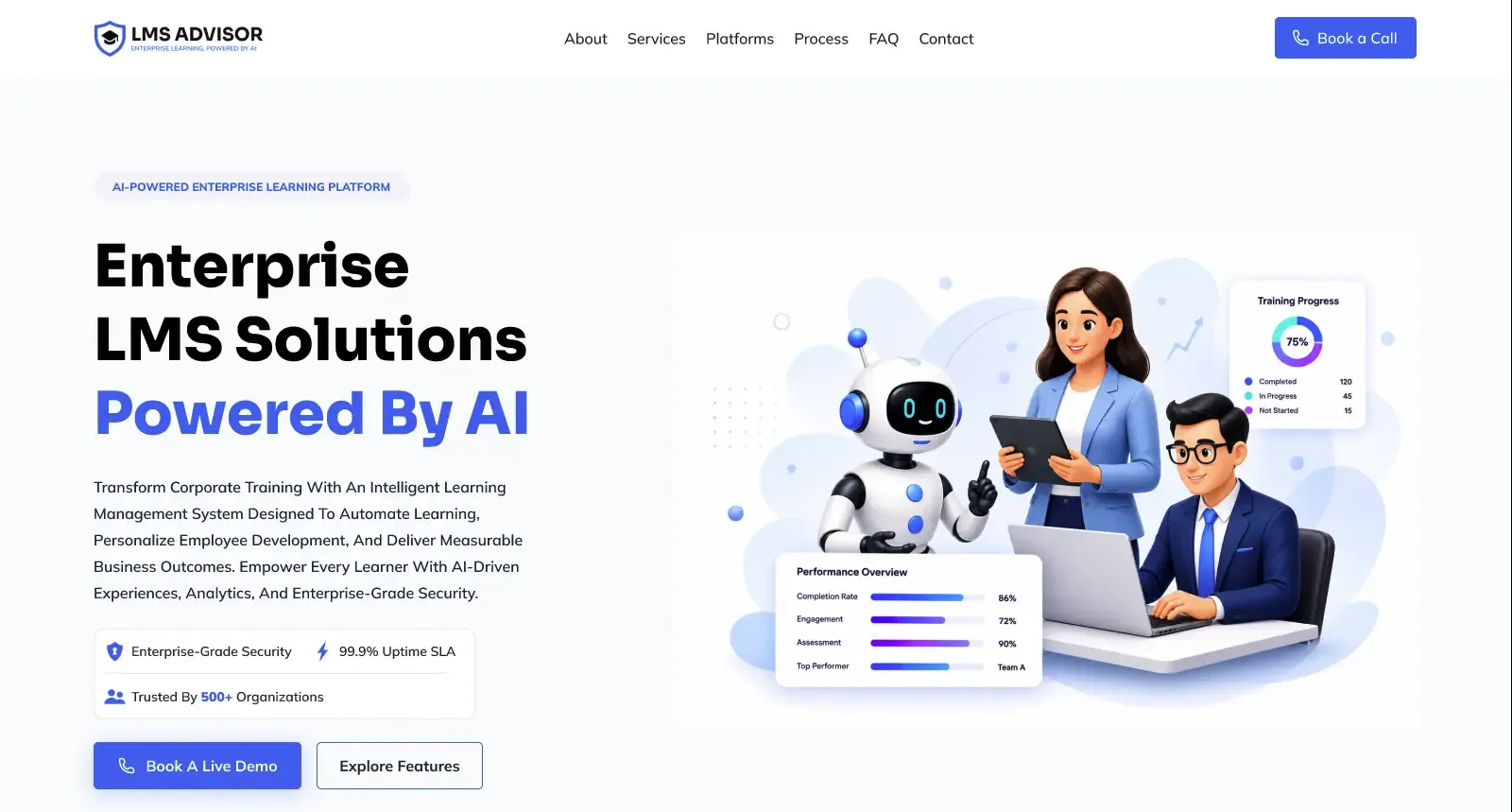 best enterprise LMS 2026[/caption]
LMS Advisor takes the top spot this year, and for good reason: it packs everything a modern enterprise needs — AI tutoring, proctored testing, certificates, gamification, and PWA mobile learning — into a single self-hosted platform that you fully own and control.
Unlike SaaS-only competitors that charge per user per month forever, LMS Advisor runs on your own infrastructure (even standard shared hosting), which slashes long-term costs and keeps sensitive training data inside your organization.
Key Features of LMS Advisor
AI Tutor built in. Learners get instant, contextual help inside every course — like giving each employee a personal trainer available 24/7. This reduces support tickets and dramatically improves course completion rates.
Complete assessment engine. Quizzes with multiple question types, timed assignments, and a dedicated Test Center for proctored exams, including shareable public test links for pre-hire screening and external candidate evaluation.
Automated certificates. A drag-and-drop certificate template designer lets you issue branded, verifiable certificates automatically the moment a learner completes a course or passes a test.
Installable PWA (mobile-first). LMS Advisor works as a Progressive Web App on iOS and Android — no app-store approval needed. Learners install it in one tap and train from anywhere, with a lesson player optimized for mobile screens.
Gamification. Points, badges, and leaderboards keep learners motivated and turn compliance training into something people actually finish.
Custom forms and data collection. A built-in form builder handles enrollment forms, feedback surveys, and training-needs assessments without any third-party tools.
Role-based administration. Granular roles — super admin, admin, manager, instructor, and student — with menu-level permissions so every team member sees only what they need.
Rich content authoring. A professional rich-text editor with visual and HTML modes supports video embeds, images, and interactive content, so instructional designers can build engaging lessons without touching code.
Analytics and reporting. Real-time dashboards track learner progress, completion rates, and assessment results so L&D leaders can prove training ROI.
Course portability. Full course export/import (including thumbnails and categories) makes it easy to move content between environments or share courses across business units.
Enterprise-grade operations. One-click database backups, built-in migration management, dark mode, and white-label branding round out a platform built for serious deployments.
Best for: Enterprises and training companies that want full ownership, predictable costs, and an all-in-one feature set without per-user SaaS fees.
2. Docebo
Docebo remains a strong choice for large enterprises invested in AI-powered content curation and extended enterprise learning (separate portals for customers and partners). With 400+ native connectors, it integrates deeply with Salesforce, Workday, and Microsoft Teams. The trade-offs: premium pricing, longer implementation timelines, and higher admin complexity.
Best for: Global enterprises with multiple training audiences and big budgets.
3. Cornerstone OnDemand
Cornerstone pairs its LMS with a full talent management suite, making it popular in regulated industries that need certification tracking tightly coupled with HR systems. It's proven and scalable, but many teams find the interface dated and the contracts rigid.
Best for: Large, regulated organizations wanting learning inside a talent suite.
4. SAP Litmos
Litmos is known for fast deployment and ease of use, with strong compliance tracking and roughly 50+ native integrations centered on the SAP ecosystem. If you already run SAP SuccessFactors, it slots in neatly; if not, its advantages shrink.
Best for: SAP-centric organizations that need quick rollout.
5. Absorb LMS
Absorb offers polished administration and strong reporting, and is a frequent pick for compliance-heavy industries. It scales well but customization depth and pricing can become sticking points for growing teams.
Best for: Compliance-intensive mid-market and enterprise training.
6. 360Learning
360Learning champions collaborative, peer-driven learning — subject-matter experts create courses internally with AI-assisted authoring. It's excellent for knowledge sharing, less so for formal certification-heavy programs.
Best for: Companies scaling training through internal experts.
7. TalentLMS
TalentLMS wins on simplicity and speed. Teams can launch courses in days, not months. It covers employee, customer, and compliance training, though enterprises with complex hierarchies may outgrow it.
Best for: SMBs and lean teams wanting a no-fuss LMS.
8. LearnUpon
LearnUpon's multi-portal architecture handles blended training across employees, partners, and customers from one place. Solid support and clean UX, but fewer advanced assessment and AI features than the leaders.
Best for: Blended employee + customer training programs.
9. Workday Learning
For organizations already on Workday, its Learning module ties training directly to employee data — managers assign modules, track completion, and report on compliance without leaving the HR system. As a standalone LMS, it's less compelling.
Best for: Existing Workday customers consolidating systems.
10. Moodle Workplace
The open-source veteran still earns its place through unmatched customization and zero licensing fees. The flip side: you'll need technical resources for setup, maintenance, and a modern user experience.
Best for: Organizations with in-house dev teams that want open-source flexibility.
Comparison Table: Top Enterprise LMS 2026
| Rank | LMS | Best For | Deployment | AI Tutor | Proctored Tests |
|---|---|---|---|---|---|
| 1 | LMS Advisor | All-in-one, full ownership | Self-hosted / Cloud | ✅ | ✅ |
| 2 | Docebo | Global enterprises | SaaS | Partial | ❌ |
| 3 | Cornerstone | Regulated industries | SaaS | Partial | ❌ |
| 4 | SAP Litmos | SAP ecosystems | SaaS | ❌ | ❌ |
| 5 | Absorb LMS | Compliance training | SaaS | Partial | ❌ |
| 6 | 360Learning | Peer learning | SaaS | Partial | ❌ |
| 7 | TalentLMS | SMBs | SaaS | ❌ | ❌ |
| 8 | LearnUpon | Blended audiences | SaaS | ❌ | ❌ |
| 9 | Workday Learning | Workday customers | SaaS | ❌ | ❌ |
| 10 | Moodle Workplace | Open-source flexibility | Self-hosted | ❌ | Plugin |
How to Choose the Best Enterprise LMS in 2026
Ask these five questions before you sign anything:
- Ownership: Do you control your data and hosting, or is it locked in a vendor's cloud?
- Total cost: Per-user SaaS fees compound fast. A self-hosted platform like LMS Advisor often costs a fraction over 3–5 years.
- Assessment depth: Can it handle proctored tests and verifiable certificates, or just basic quizzes?
- Mobile experience: Is there a true installable app experience (PWA) or just a responsive website?
- AI capabilities: Does AI actively help learners (like LMS Advisor's AI Tutor), or is it just a marketing checkbox?
Final Verdict
Every platform on this list serves a niche, but LMS Advisor is the best enterprise LMS of 2026 for organizations that want the complete package — AI tutoring, proctored testing, certificates, gamification, and mobile learning — with full ownership and no per-user tax. Docebo and Cornerstone remain solid for enterprises committed to big-vendor SaaS, while Moodle suits teams with developers to spare.
Ready to see the #1 LMS in action? Try LMS Advisor free and launch your first course today.
FAQ
What is the best enterprise LMS in 2026?
LMS Advisor ranks #1 in 2026 thanks to its built-in AI Tutor, proctored Test Center, automated certificates, gamification, and self-hosted deployment that eliminates per-user fees.
How much does an enterprise LMS cost in 2026?
SaaS platforms typically charge $4–$15 per user per month. Self-hosted options like LMS Advisor use one-time or flat licensing, making them far cheaper at scale.
Can an LMS run proctored exams?
Most mainstream LMS platforms can't natively. LMS Advisor includes a dedicated proctored Test Center with public test links for both employees and external candidates.
Is a self-hosted LMS better than SaaS?
For data-sensitive or cost-conscious enterprises, yes — you keep full control of data, branding, and costs. SaaS wins mainly on hands-off maintenance.
Add trusteditfirms.com as a preferred source on Google, or open this page in your AI assistant to use it as a source.