
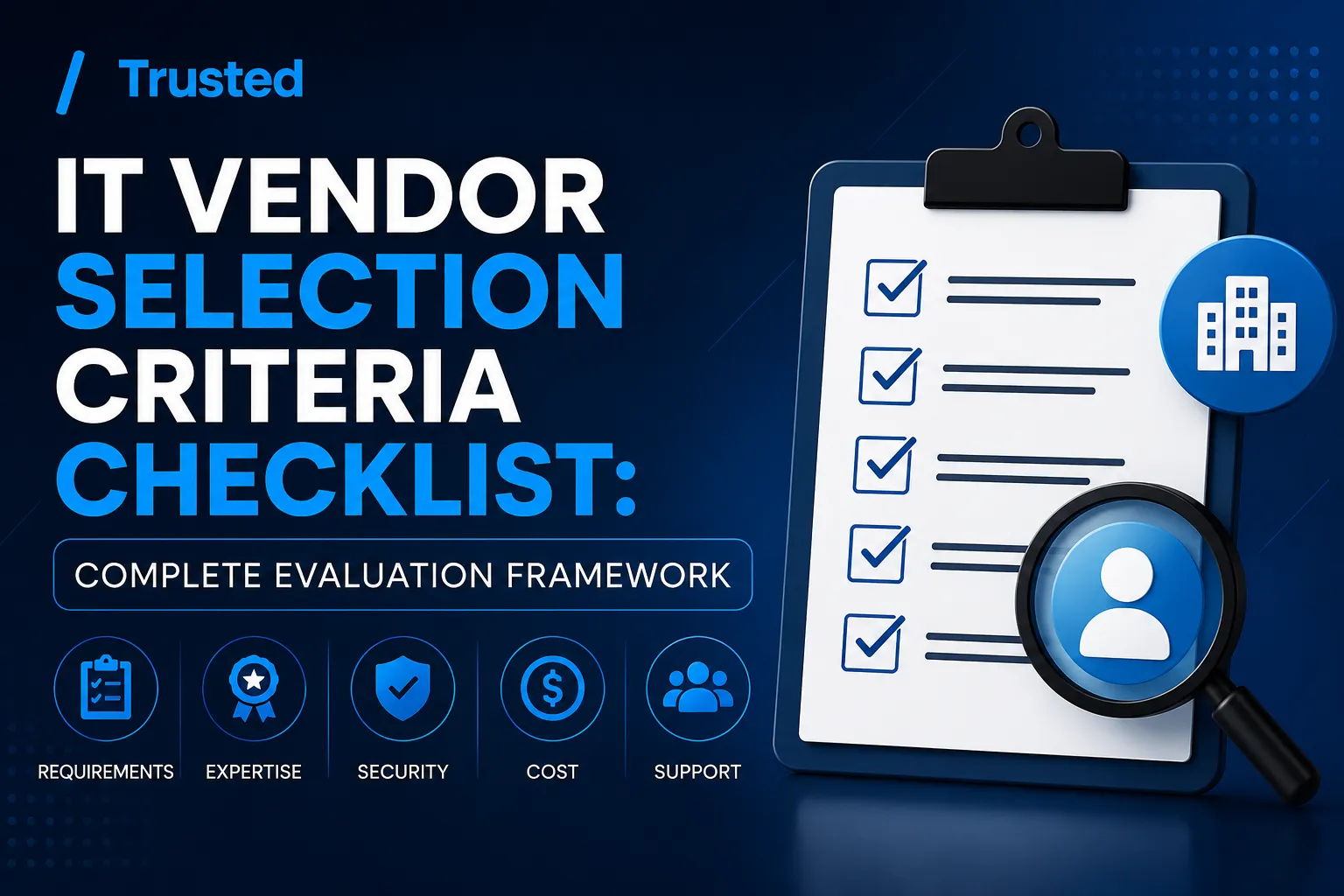
Choosing the right IT vendor can determine whether your next digital initiative succeeds or becomes a costly failure. A comprehensive IT vendor selection criteria checklist transforms what is often a rushed, intuition-driven decision into a structured evaluation framework that protects your organization from technical mismatches, security vulnerabilities, and partnership failures that emerge months after contracts are signed.
Why a Structured IT Vendor Selection Process Matters
Poor data quality costs the average company between $12.9 million and $15 million per year, per Gartner estimates, yet many organizations still approach vendor selection without documented criteria or cross-functional input. The financial consequences extend beyond data quality issues. Too many founders treat the vendor selection process like a checklist item instead of the strategic risk decision it actually is, leading to missed deadlines, ballooning costs, unhappy customers.
A structured approach delivers measurable advantages. Vendor Management Systems (VMS) and structured processes typically cost around 0.5% of total spend but deliver ROI through cost savings, improved quality, process efficiencies, and reduced risk exposure. Organizations implementing formal frameworks also gain competitive advantages: Organizations using structured vendor evaluation criteria report significantly fewer project failures.
Beyond cost avoidance, systematic vendor selection prevents operational disruption. Research from Riskmethods revealed that 79% of businesses have lost 4% of revenue due to supply chain disruptions in the past three years. When vendors experience financial instability or fail to meet service commitments, the impact cascades through your operations. A well-designed IT vendor selection criteria checklist forces evaluation of financial health, service level guarantees, and exit provisions before you commit resources. For organizations seeking guidance on broader technology partnerships, our guide on choosing the right technology consulting company offers additional strategic considerations.
Essential Technical Capability Criteria
Technical capabilities represent the foundation of any vendor evaluation, yet superficial assessments remain common. Organizations must verify that vendors possess not just current technical skills but the architectural maturity to support long-term integration and scaling requirements. It's not just about what a vendor offers, but also how they get it to you. Is it on-premises or cloud-based? Will it involve self-service where you'll manage things yourself, or is it full-service where the vendor takes care of everything? Also, consider whether you're looking at a project-based delivery or retainer-based. Understanding these helps decide if their model aligns with your specific needs, resources, budget, and strategic objectives.
Methodology and development practices deserve scrutiny beyond marketing materials. Request evidence of the vendor's software development lifecycle, quality assurance protocols, version control practices, and deployment procedures. Vendors operating in your specific industry should demonstrate domain expertise through relevant case studies. If a vendor successfully handled 'big jobs' in your industry, that's a big green light. It suggests they can handle your unique requirements confidently. These projects often come with heightened expectations and unique challenges, requiring specific skill sets to manage effectively. If a vendor has successfully navigated these waters, it implies they possess the knowledge, resources, and problem-solving abilities necessary for your project's scope and complexity.
Integration capabilities often determine implementation success more than feature lists. Evaluate API availability, documentation quality, existing integration partnerships, and data migration support. Ask vendors to demonstrate integration with your current technology stack during proof-of-concept phases. Organizations selecting application development firms should verify experience with your preferred frameworks and infrastructure. Technical capability assessment must also address scalability: can the vendor's solution handle your projected growth in users, transactions, and data volume without requiring a platform migration within three years?
Security and Compliance Requirements
Security vulnerabilities in vendor systems create direct pathways for attackers to access your data and networks. According to Verizon's 2022 Data Breach Investigations Report, 62% of system intrusion incidents involved third parties (partners, vendors, or suppliers), though more recent data from 2026 shows third-party involvement in 48% of breaches, making vendor security assessment a critical risk management function rather than a procedural formality. , while regulatory penalties for inadequate vendor oversight have reached record levels.
Your vendor security evaluation must verify specific controls across multiple domains. Checking that your vendors have appropriate security controls is a priority for any effective vendor risk assessment. You want to check that they have robust processes for patch management and software updates; regularly scan for vulnerabilities and anomalies; keep on top of threat intelligence; and have reliable incident response policies. Request documentation of encryption standards for data at rest and in transit, multi-factor authentication requirements, access control policies, and security incident response procedures. Vendors should provide evidence through security questionnaires, not just attestations.
Compliance certifications provide objective validation of security maturity. Frameworks such as SOC 2, ISO 27001, HIPAA, GDPR, and PCI DSS all mandate structured vendor risk evaluations as part of their control requirements. Specifically, ISO/IEC 27001 emphasizes third-party security controls as part of its Annex A requirements. SOC 2 requires evidence of how an organization manages third-party risk under the Trust Services Criteria. NIST SP 800-171 demands that contractors handling Controlled Unclassified Information (CUI) assess and manage the security posture of their supply chain. Request current audit reports, not just certificates, and verify the scope covers systems that will handle your data. Organizations managing multiple technology vendors should explore vendor management systems that centralize security documentation and automate compliance tracking across your entire vendor portfolio.
Financial Stability and Pricing Evaluation
Vendor financial health determines whether your technology partner can fulfill contractual obligations throughout the engagement lifecycle. When a vendor has poor financial stability, you may see a decline in service levels, termination of products or services, and rapid staff turnover—disruptions that cascade directly into your operations.
Financial statement review, liquidity evaluation, creditworthiness, background validation, and compliance alignment form the foundation of rigorous financial due diligence. Request three years of audited financials and examine specific ratios: current ratio of 2.3 indicates stable liquidity, while 0.8 signals cash flow vulnerability. For private vendors, request the form 10-K or audited financial statement online for public companies, or request directly from the vendor if it's a private company.
Venture-backed startups require additional scrutiny. Ask the vendor for their current cash runway and monthly burn rate; if the vendor relies entirely on raising a new round of venture capital every twelve months to survive, they are an extreme operational liability. Industry analyses show the cost of migrating from a failed scheduling system can range from 1.5 to 5 times the original implementation cost (MyShyft 2025), making financial vetting a critical risk mitigation step.
Pricing transparency matters as much as cost. Evaluate total cost of ownership—implementation fees, licensing models, support tiers, data migration expenses, and exit costs. Require the vendor to provide annual financials or maintain specific financial metrics as contractual obligations. Build contingency plans and identify alternate vendors before financial red flags escalate into service failures.
Service Level Agreements and Support Standards
SLAs are an integral part of an IT vendor contract, pulling together information on all the contracted services and their agreed-on expected reliability into a single document. Without enforceable SLAs, performance expectations remain ambiguous and disputes become inevitable.
Effective SLAs define measurable service standards across multiple dimensions. Performance metrics are the measurable standards your team commits to meeting—response times, resolution times, uptime percentages, and other quantifiable targets give everyone a clear benchmark for success. Industry data from 2024 shows that organizations with clearly defined SLA metrics experience 50% fewer service-related disputes and achieve higher overall satisfaction scores.
Demand specificity in service elements. Service elements include specifics of services provided (and what's excluded), conditions of service availability, standards such as time window for each level of service, responsibilities of each party, escalation procedures, and cost/service tradeoffs. Negotiate penalties for non-compliance: SLAs include agreed-upon penalties in the event a service provider fails to meet the agreed-upon service levels, including fee reductions or service credits against the fees incurred by the customer as well as termination of the contract for repeated failures.
Cloud vendors typically resist customization, but in some cases, customers are able to negotiate terms with their cloud providers. SLAs should include a clearly defined framework for modification during the term of the contract, ensuring agreements evolve alongside business requirements and vendor capabilities. Review SLAs quarterly for critical vendors and annually for lower-tier relationships. For deeper insight into managing vendor relationships systematically, explore vendor management systems that streamline procurement workflows.
Cultural Fit and Communication Assessment
Technical capability alone cannot predict partnership success. Cultural fit ensures alignment between values, communication styles, and work approaches, fostering smoother collaboration and understanding while promoting shared goals and reducing conflicts. Misaligned cultures generate friction, miscommunication, and project delays regardless of technical excellence.
Perform cultural audits of potential vendors to understand their corporate culture, values, and work practices; use structured interviews and surveys to gather insights into how vendors handle cultural differences, communication, and conflict resolution. Evaluation can include reviewing the vendor's website, social media presence, and online reviews, as well as conducting interviews with key personnel, site visits, and reference checks.
Assess communication protocols and decision-making structures. Conduct simulated communication scenarios to assess how effectively potential vendors communicate across cultural boundaries; ensure that key team members from the vendor possess adequate language skills to facilitate clear and effective communication. Evaluate response time expectations, escalation paths, and reporting cadences—these operational rhythms reveal whether vendor workflows align with your internal tempo.
Initiate small-scale pilot projects to test the cultural compatibility between the internal and vendor teams before committing to a long-term partnership; establish feedback mechanisms during the pilot phase to identify and address cultural misalignments early. Pilot engagements expose friction points at minimal cost and commitment. When evaluating technology consulting companies, cultural compatibility often predicts long-term satisfaction more accurately than feature checklists or pricing models.
Reference Checks and Vendor Track Record
Reference checks represent the final validation layer before contract signature, yet effective screening includes conducting background checks, verifying references, and reviewing financial data according to Cisive (2026). The "magic question" is simply, "Would you work with this vendor again?" and even if the overall review wasn't stellar, if they answer "yes," you can be fairly certain the vendor was acceptable as noted by WW&D in 2025.
Request the complete client roster rather than accepting pre-selected references. Request a complete list of the vendors customers but select no more than five comparable libraries from this list, and make your selections independent of the vendor's suggestions advises Library Technology Guides. Focus specifically on organizations that match your size, industry, and technical complexity—a fintech startup's experience differs dramatically from an enterprise healthcare deployment.
Evaluating the vendor's track record and knowledge in the sector involves considering the number of years of experience the vendor has in the industry, their technical capabilities, and their specific market knowledge according to RD-ITS (2024). Examine project completion rates, average client tenure, and whether references describe proactive problem-solving or reactive firefighting. Ask references about measurable impact this vendor has had on your business outcomes or KPIs to surface concrete value delivery beyond generic satisfaction ratings.
Structure reference conversations around crisis scenarios: implementation delays, security incidents, and scope changes. Allow at least a half-hour of time, and keep your schedule clear for a half-hour after the call in case your meeting runs over recommends WW&D. Document responses immediately and compare patterns across multiple references—isolated complaints signal manageable friction, while repeated themes indicate systemic vendor weaknesses that will resurface in your engagement.
Downloadable IT Vendor Selection Checklist
A comprehensive vendor selection checklist transforms subjective vendor comparison into defensible procurement decisions. Selection criteria make decisions defensible by tying requirements to scores, scores to rationale, and rationale to outcomes, creating an audit trail your security, finance, and legal teams can stand behind according to TechnologyMatch (2026).
Your checklist should segment evaluation into weighted categories: technical capability (25%), security posture (20%), financial stability (15%), service delivery (20%), cultural alignment (10%), and pricing structure (10%). These criteria can include technical expertise, service-level agreements (SLAs), pricing, innovation, vendor financial stability, compliance with industry regulations, and more notes OneIO Cloud (2026). Assign scoring thresholds where vendors below 70% aggregate scores trigger automatic disqualification regardless of strength in individual categories.
Include binary pass/fail gates alongside scored criteria: SOC 2 Type II certification, cybersecurity insurance minimum $5M, financial audit within 18 months, and dedicated account management. Assign weights to each evaluation criterion to reflect its relative importance to your business, as security may carry a higher weight compared to other criteria if it's a critical factor according to OneIO Cloud. Document evidence requirements for each criterion—vendor claims require third-party validation, not marketing collateral.
Structure your checklist as a living document that feeds into quarterly vendor management systems reviews post-contract. Continuously monitor and measure vendor performance using your scorecard, and periodically review and update the evaluation criteria as needed to ensure vendors are held accountable and are meeting your expectations throughout the duration of the relationship recommends OneIO Cloud. This continuity transforms selection criteria into operational KPIs, closing the loop between vendor promises and delivery reality while establishing clear performance benchmarks that justify renewal or termination decisions.
FAQ
What is the most important criterion when selecting an IT vendor?
Security and compliance requirements typically rank highest for enterprise IT decisions, as vendor breaches expose your organization to regulatory penalties and reputational damage. However, criterion importance varies by project criticality—mission-critical systems prioritize uptime and support responsiveness, while innovation projects may weight technical capability and roadmap alignment more heavily. Define your specific risk tolerance and strategic objectives before assigning weights.
How many vendors should I evaluate during the selection process?
Narrow your evaluation to three finalists after initial screening to balance thoroughness with decision efficiency. Broader initial research across 8-10 candidates helps establish market benchmarks, but deep evaluation—including reference checks, security audits, and proof-of-concept testing—becomes prohibitively time-consuming beyond three vendors. This approach prevents analysis paralysis while ensuring adequate competitive tension during contract negotiations.
Should I prioritize established vendors or emerging providers?
Established vendors offer proven stability and mature support infrastructure but may lack agility and innovation velocity. Emerging providers deliver cutting-edge capabilities and competitive pricing yet carry higher financial and operational risk. Mitigate emerging vendor risk through shorter initial contract terms, detailed escrow arrangements for intellectual property, and parallel redundancy planning. Match vendor maturity to your risk appetite and the strategic importance of the capability being sourced.
How often should I reassess vendor performance after contract signature?
Conduct formal quarterly reviews for strategic vendors and annual assessments for tactical suppliers. Front-load evaluation frequency during the first 12 months post-implementation, as this period surfaces integration issues, support quality, and cultural fit problems that initial due diligence may have missed. Tie review cadence to contract value and operational criticality—vendors managing sensitive data or mission-critical systems warrant monthly monitoring regardless of relationship maturity.
What should I do if a vendor fails reference checks but excels in other criteria?
Reference check failures represent red flags that typically predict future relationship problems regardless of technical capability or pricing advantages. If proceeding despite negative references, implement enhanced oversight: shorter payment terms, performance bonds, detailed milestone-based contracts, and executive escalation paths. Consider whether the capability gap justifies the elevated risk, or if technology consulting companies can provide interim solutions while you continue vendor search efforts.
Find Pre-Vetted IT Vendors
Skip the lengthy evaluation process. Browse our directory of verified IT service providers who've already met rigorous selection criteria, saving you time and reducing procurement risk.
Add trusteditfirms.com as a preferred source on Google, or open this page in your AI assistant to use it as a source.